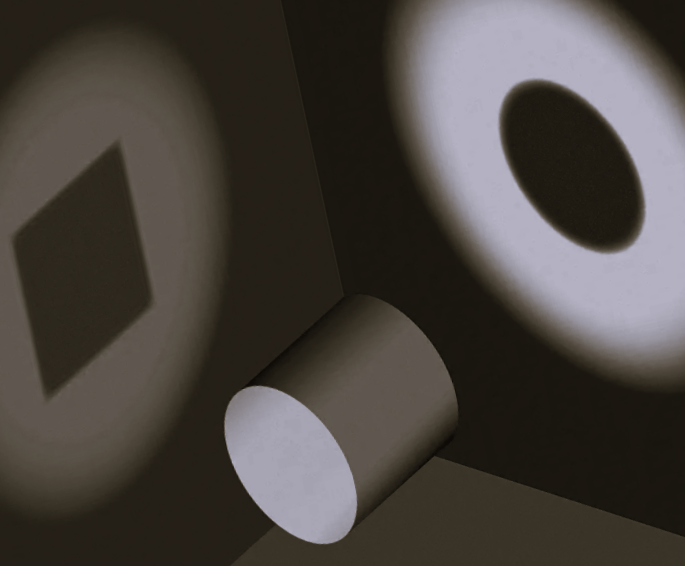
When a father reads his child about a square circle, the child believes this to be true. When the child wonders ‘how can this be true’, the father might answer: I don’t know, but it is true. At this point a child faces at young age a leap of faith. Do I believe my father when he says something I don’t understand is true?
Although we take to any religious scripture an enormous step forward, the same problem rises. What if any religion has what appears as inconsistencies to us? How do we respond to these inconsistencies?
At this point faith inevitably enters our interpretation of religious scriptures. We cannot observe any of the objects religious scriptures talk about. So when we decide to give any scripture the favour of doubt, that is, we trust there to be an explanation we don’t yet see, but hold the scripture for true, we have faith.
The same is true with the opposite. If we, for any reason, conclude that any religious scripture is inconsistent and therefor unreliable, or not true, we have taken the same step of faith. Even if it is a calculated step of faith, where the pro’s and con’s might have been treated as mathematical possibilities. The end is sheer faith, for any conclusion.
One problem with faith is that it is not only intellectual. We might argue that we are, but a fundamental problem is our own attitude towards our own mind. Do I trust my mind always to be right? Do I never trust my mind? We constantly navigate a scale between arrogance and insecurity.
The problem is that we are not intellectually objective. Not only are we preassumptive (even if it is just by upbringing), we also bear the burden of our attitude towards complex questions.
Can we escape religious inconsistencies? We can ignore them, but we cannot solve the questions. We have to take the leap of faith and believe its truth, accepting that our mind cannot fully understand its working. Or we don’t accept its truth, maybe because our mind cannot understand the inconsistencies.
We must decide.
Explore similar topics:
 Understanding religion and philosophy
Plaats een reactie